
Adelaide Jetty and Wharf Condition Assessments
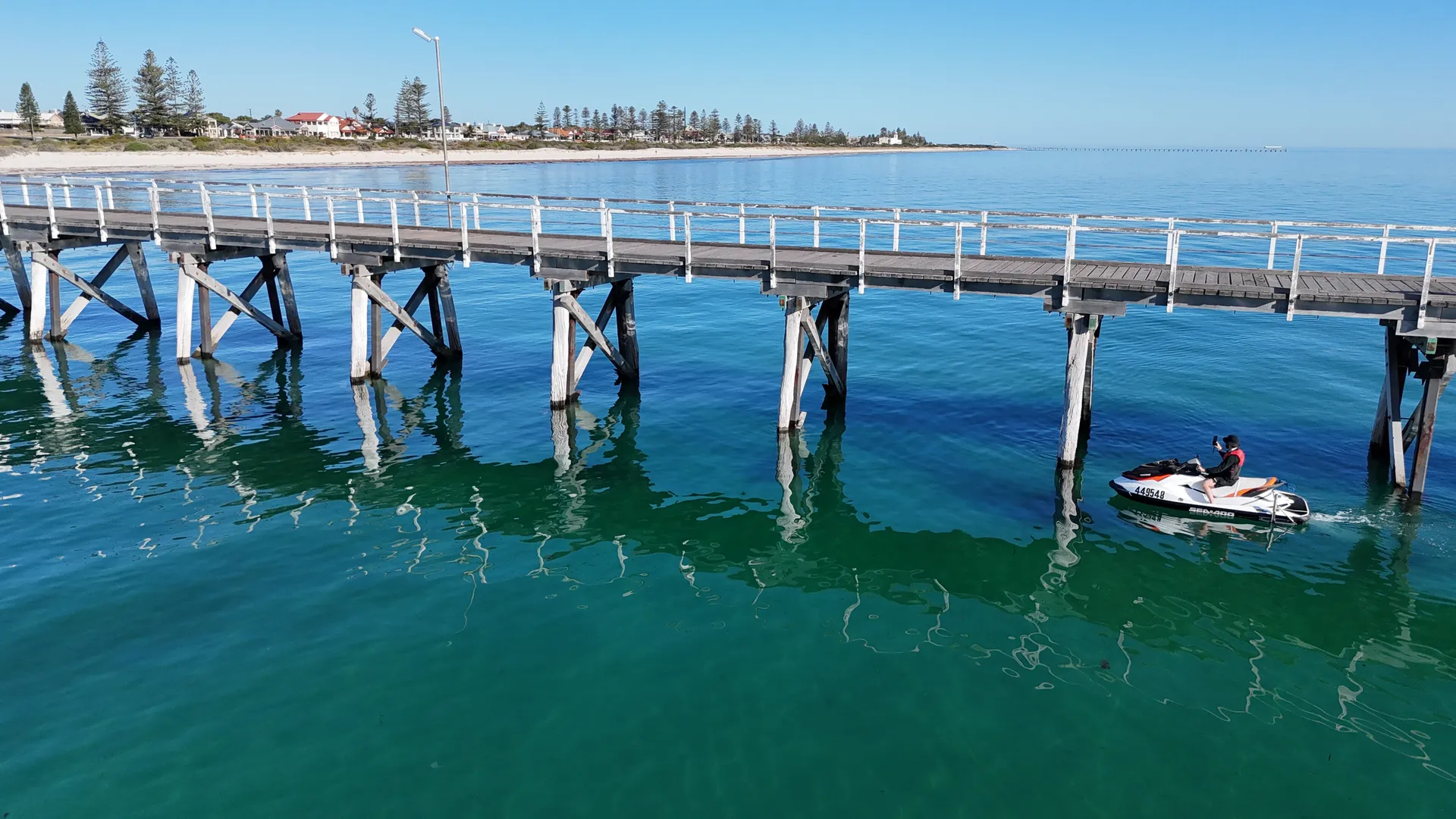
Level 2 WSCAM condition assessments of three ageing public marine structures on metropolitan Adelaide's coast: the jetties at Largs Bay and Semaphore, and the Adelaide Shores Wharf at West Beach. The work gives the Department for Infrastructure and Transport consistent, evidence based condition data to direct maintenance and plan for the long term.
The challenge
Largs Bay Jetty, Semaphore Jetty and the Adelaide Shores Wharf at West Beach are long serving public marine structures on the metropolitan Adelaide coast, carrying fishing, tourism and boating traffic on timber and steel members that sit permanently in the splash zone. Structures like these age quietly. Deterioration progresses out of sight beneath the deck and below the waterline, and without current data an asset owner is planning maintenance on assumptions rather than evidence. The Department for Infrastructure and Transport engaged Magryn to inspect all three assets and rate them against the Wharf Structures Condition Assessment Manual (WSCAM), the national framework for the inspection and condition assessment of marine assets. The Department needed results that were consistent between the three structures and comparable with earlier inspections, so condition could be tracked over time and maintenance directed where it matters most.
Our approach
Marine structures like these are hard to keep an honest picture of, because the parts that decide their condition are the parts nobody sees. Members sit permanently in the splash zone, girders and crossheads deteriorate under the deck, and the piles carry on below a waterline the public never gets past. Each of the three structures was therefore inspected on foot at low tide from beneath the deck, with a small watercraft used to reach spans that cannot be walked to and an underwater assessment of the piles brought into the same record. The work followed the Level 2 condition rating procedure in the Wharf Structures Condition Assessment Manual, with every component numbered to its bent, rated against the WSCAM scales for steel, timber and concrete, and photographed on site as it was rated, so nothing depended on notes written up afterwards. Each rating was then paired with a maintenance priority, which states how soon a component needs attention rather than only how far it has degraded. Holding all three assets to the same framework and the same numbering is what allows the results to be read against each other, and against the next inspection.
The outcome
Each of the three assets has its own condition assessment report recording every component, its condition rating and the recommended action, supported by heat maps that show at a glance where attention is needed along the structure. Recommendations are sorted into replace, repair, investigate and monitor and tied back to maintenance priority, so the Department for Infrastructure and Transport can build a works programme around the items that genuinely drive risk. Because all three assets were assessed to the same framework by the same team, the results can be compared against each other and against future inspections. That gives the Department a defensible evidence base for maintenance budgeting and for longer term decisions about these structures. For the public, it means the jetties and wharf that draw people to Largs Bay, Semaphore and West Beach stay safe, well maintained and open.
Project gallery
Similar work
Talk to us about a similar project, or browse more of our work.