
Mudjimba Island Boat Mooring Anchor Design
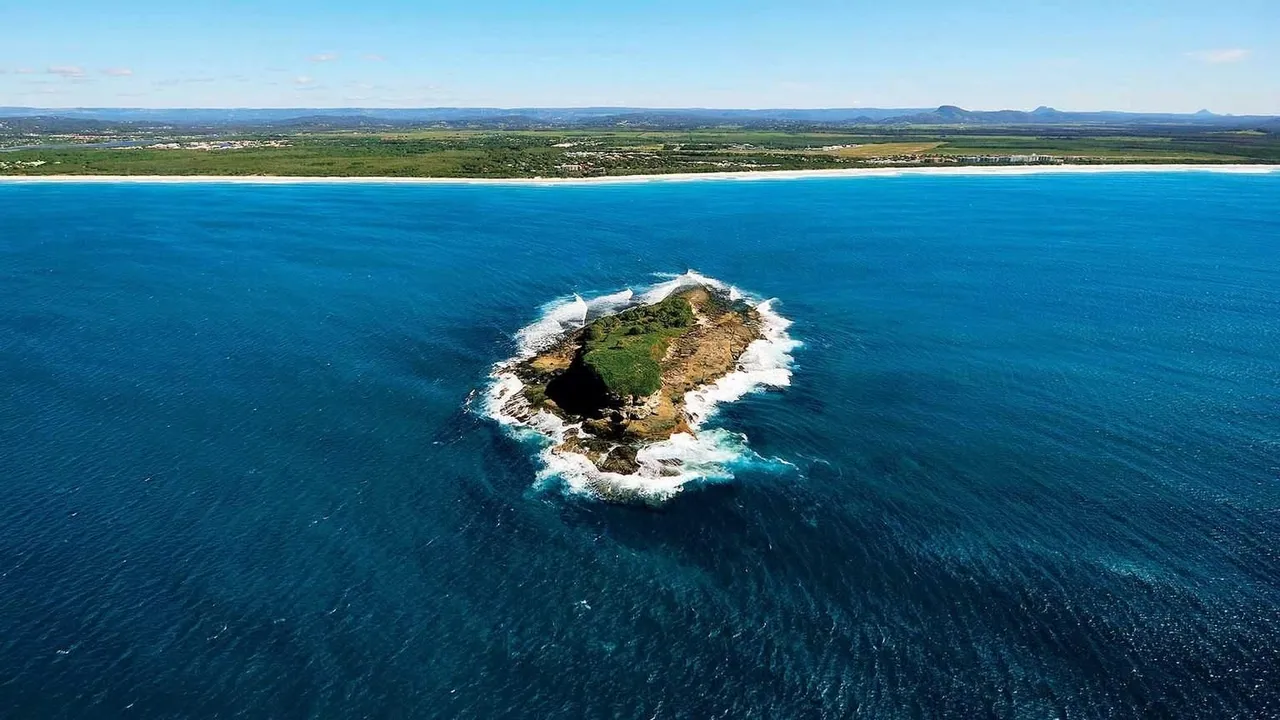
Mooring analysis and mass concrete anchor design for vessel moorings at Mudjimba Island off the Sunshine Coast in Queensland, giving Queensland Parks and Wildlife Service one standard block that serves both tender and A class moorings.
The challenge
Mudjimba Island sits roughly a kilometre off the beach at Mudjimba on the Queensland Sunshine Coast, a small island that draws surfers, snorkellers and divers. The water around it is shallow and reef dominated, with the island itself perched on a reef shelf, and Queensland Parks and Wildlife Service needed proper moorings so visiting vessels have a secure place to tie up. Designing an anchor for that setting is not simply a matter of sinking a heavy block. It has to hold vessels of quite different sizes against the wind, waves and currents the site genuinely experiences, on a seabed that changes from rock to sand as the water deepens, and it has to be small enough to be cast, transported, lifted and positioned by divers at an exposed offshore island. QPWS also asked for the smallest practical block size, readily available marine hardware, and where possible a single mould that could serve every mooring.
Our approach
Mooring anchors are awkward things to design. Holding power comes from mass and seabed friction, yet the same block has to be cast, transported, lifted and set down accurately by divers at an exposed offshore island, and at Mudjimba it lands on a bed that changes from rock to sand as the water deepens, under vessels of quite different sizes. Regional wind records, wave data and bathymetry for the Sunshine Coast, together with dive observations of the seabed around the island, established what a mooring would face at each candidate location and depth. Dynamic mooring analysis then put the vessels on their lines and traced the loads back down to the anchor, singling out the intermediate depth of about 11 metres as the governing case, since it combines significant wave energy at the seabed with a transitional rock to sand bed that offers less friction than the sand further out. Only once those loads were settled did the block itself take shape, with four configurations compared for holding capacity, ease of casting, handling and diver assisted installation before the preferred arrangement was agreed with QPWS.
The outcome
The design delivers a single standard mass concrete anchor block, 1.1 metres square and one metre high at about three tonnes, used on its own for tender class moorings and in a group of three around a central mooring ring for A class vessels. One mould, one reinforcement arrangement and one set of connection details cover both mooring types, which simplifies fabrication, keeps individual lifts within reach of modest vessels and plant, and makes placement by divers straightforward. Inside each block a steel frame runs diagonally to the corners so that load from the central mooring connection is spread across the full footprint of the anchor rather than concentrated at one point, avoiding local cracking. Steelwork is detailed for a 25 year life in severe marine exposure, with section loss from corrosion carried through the strength checks, hot dip galvanising and marine grade coatings applied to exposed components, and consumable items such as lines and shackles able to be swapped out on a routine inspection cycle. Queensland Parks and Wildlife Service ends up with a standardised, repeatable mooring anchor that can be rolled out at other sites, and visitors to Mudjimba Island get moorings designed for the operating conditions the island actually sees.
Similar work
Talk to us about a similar project, or browse more of our work.