
Sheet Pile Seawall Condition Assessment and Remediation Options
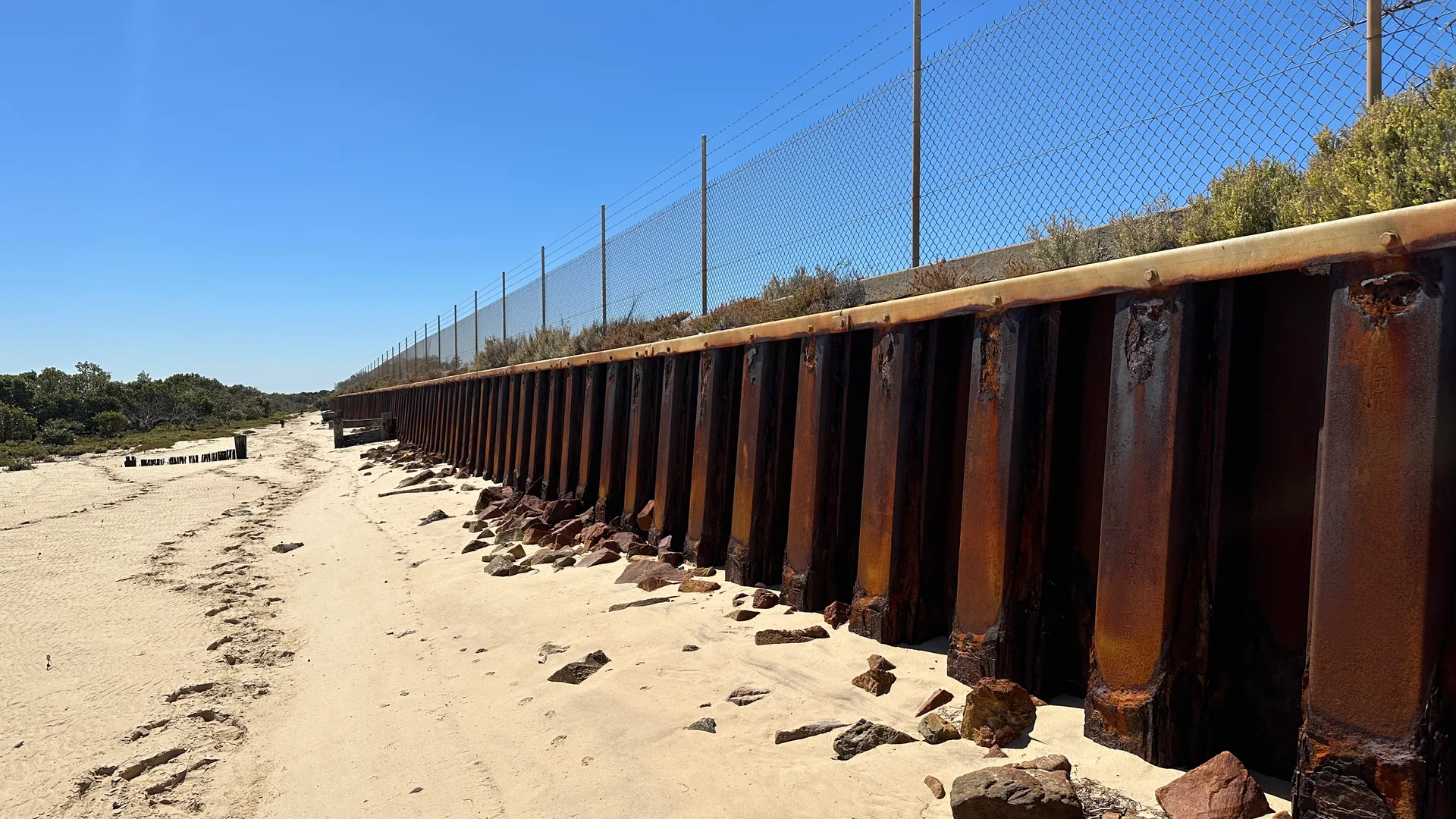
Structural condition assessment and concept remediation options for a corroded steel sheet pile seawall in an aggressive South Australian coastal environment, establishing the remaining serviceable life and a ranked path to restoring the protection the site depends on.
The challenge
A driven steel sheet pile wall protects a private client's coastal site in South Australia, retaining the ground behind it and standing between the site and the beach. After decades in one of the most aggressive environments a steel structure can occupy, the wall was showing extensive corrosion and section loss along its length. The client needed to know how much serviceable life remained, what the consequences would be of leaving it as it was, and what the realistic options were for restoring the protection it provides. Operational infrastructure sits close behind the wall and sensitive coastal vegetation fringes the beach in front of it, so any solution had to work within a narrow corridor and leave the surrounding environment undisturbed.
Our approach
The client had to decide whether to repair a corroded steel sheet pile wall or replace it, and that call could not be made on appearance alone. The wall was inspected on site and opened up at intervals along its length so the remaining steel thickness could be measured rather than estimated, and those measured sections were carried into retaining wall analysis to establish what capacity, and what serviceable life, was left. Corrosion and section loss proved to be the governing issue rather than any single localised defect, and the extent of it meant that conventional maintenance such as blasting and recoating would not return the wall to a serviceable standard. The assessment also took account of the conditions the wall stands in, from the geotechnical profile and survey to the tidal zone it passes through and the water levels reaching it, with 1 in 100 year storm levels modelled for present day and for 2075. With the brief settled on restoring the wall's retaining and erosion protection functions, four concept options were then developed far enough to be compared on their merits, and assessed side by side on durability in a harsh marine environment, constructability within a narrow working corridor, maintenance demand, environmental impact and long term risk.
The outcome
The client has a documented position on the condition of the wall and a defensible basis for acting on it. Four concept options are set out and ranked, with a rock armour revetment recommended as the preferred solution: it is durable in a marine environment, needs little maintenance, and dissipates wave energy rather than reflecting it back onto the beach where that accelerates erosion. Its crest can also be raised in future if sea level rise makes that necessary. Staged delivery in sections over several years is mapped out, so the works can be matched to the site's operational planning, with the implications of deferral stated plainly rather than left implicit. The recommended concept restores both functions the original wall performed, retaining the ground behind it and protecting the site from coastal erosion, over a 50 year design life. It also sets out the approvals pathway that applies where works meet the South Australian coast, so the next stage can proceed without surprises.
Similar work
Talk to us about a similar project, or browse more of our work.