
Sheringa Beach Access Stairs Replacement Design
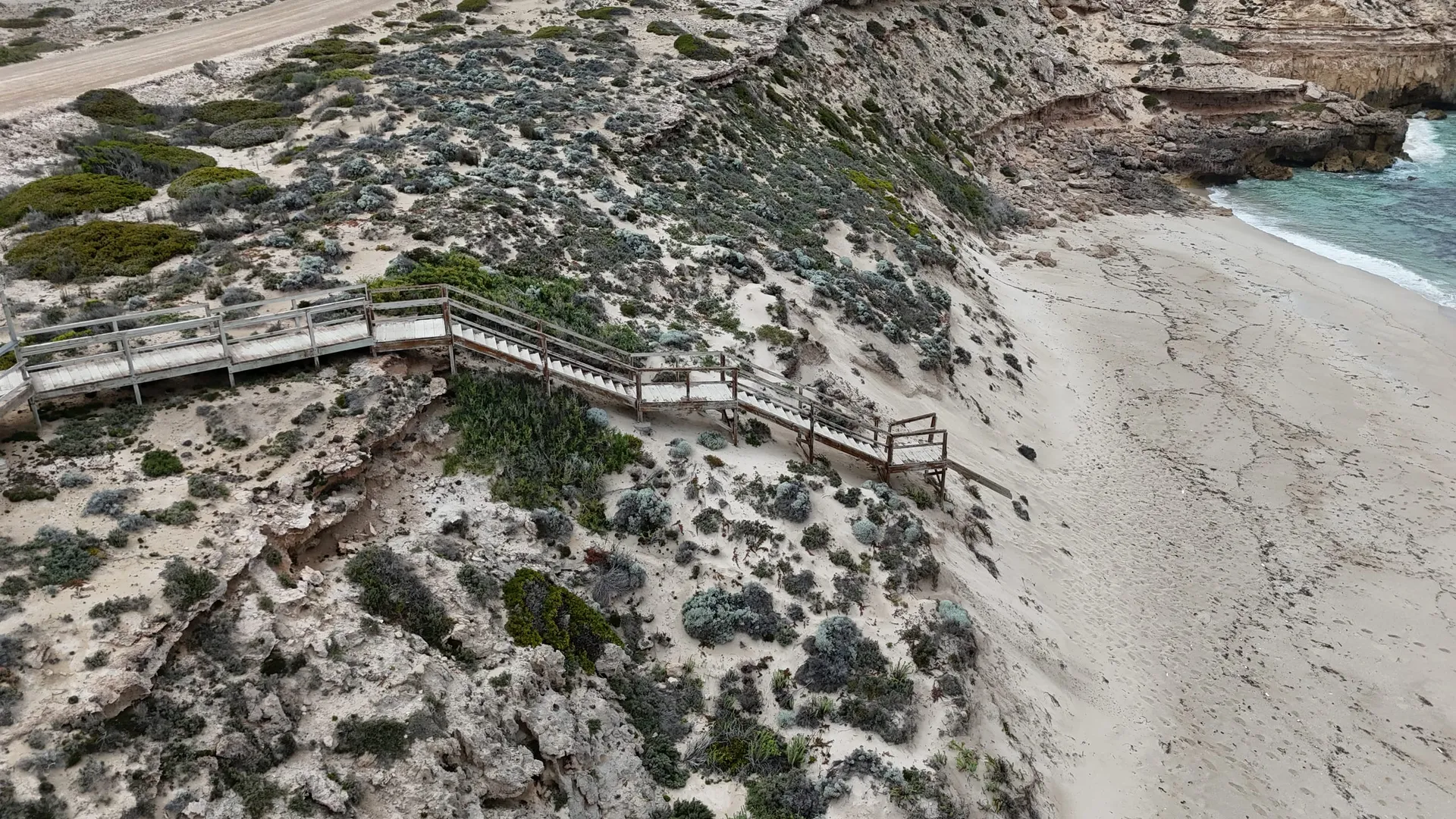
Storm damage assessment and replacement design for the public beach access stairs at Sheringa Beach on the western Eyre Peninsula, realigned onto more stable ground so the new structure can withstand the dune erosion and wave exposure of an open Southern Ocean coast.
The challenge
Sheringa Beach lies about 350 km west of Adelaide, facing south west into the full energy of the Southern Ocean. The timber stairs from the carpark are the formal public access to the beach, dropping around ten metres down a steep dune and rock slope. Storm waves cut into the dune face and undermined the lower footings, leaving them suspended above the ground before the bottom section of the staircase, two flights and a landing, collapsed and was swept onto the sand. Continuing dune recession left what remained of the lower structure exposed to the next event. For the District Council of Elliston the question was not simply how to rebuild, but how to rebuild in a position and form that would not be lost again.
Our approach
The decision Council faced was about position, not timber sizes, whether to reinstate the collapsed flights where they stood or shift the access onto more stable ground. Supporting that call meant putting numbers to the slope. Site inspection, drone imagery and LiDAR levels fixed the geometry, about ten metres of fall from carpark to beach on a face pitched near one in three, and showed where the erosion scarp had cut and where erodible sand gives way to competent carbonate rock. Design water levels came from the 1% AEP storm tide, close to 2.4 metres AHD once the 0.3 metre sea level rise allowance to 2050 required by state coastal policy is carried across the stair's fifty year design life, and on that evidence rebuilding straight down the active sandy face could not be justified. The design instead takes the main stair run north into the rock supported part of the slope, keeps the existing upper landing and carpark connection, founds the primary posts on non-erodible rock, and details timber members, fixings and connections for severe coastal exposure. Geotechnical investigation to confirm rock quality is recommended before detailed design.
The outcome
The design reinstates safe public access to Sheringa Beach on an alignment chosen for its stability, with primary support posts founded on non-erodible rock so the structure is far less vulnerable to undermining and scour in storms. The existing upper landing and carpark connection are retained, keeping the familiar route to the beach, limiting the extent of new works and reducing disturbance to a sensitive dune system. Timber members and fixings are detailed for severe coastal exposure, and design water levels carry an allowance for sea level rise across a fifty year design life. The lower landing sits slightly north of the old one, away from the most active part of the dune face, while still delivering users to much the same point on the beach. For the District Council of Elliston, the result is restored beach access with a realistic service life and a far lower chance of repeating the same loss after the next big Southern Ocean storm.
Similar work
Talk to us about a similar project, or browse more of our work.