
Tumby Bay Seawall and Beach Access Ramp
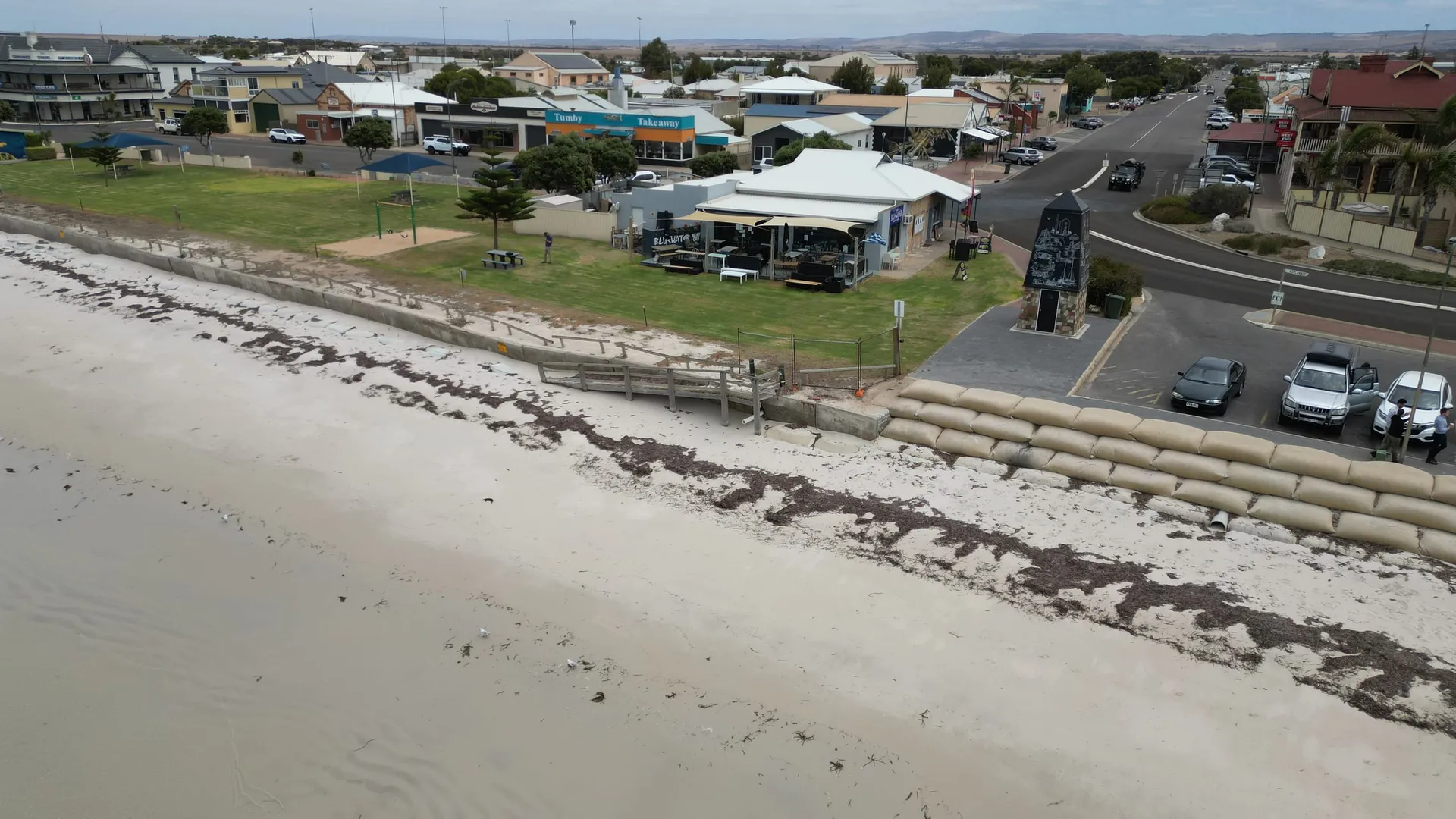
Detailed design of a geotextile sand container seawall and a modular, DDA compliant beach access ramp on the Tumby Bay foreshore, Eyre Peninsula, protecting the township reserve from coastal erosion and wave overtopping while restoring safe public access to the beach.
The challenge
Tumby Bay sits on the eastern side of Eyre Peninsula and faces into Spencer Gulf, and its township foreshore has been held by a succession of protection structures built over many years. Along one segment fronting the reserve, the vertical concrete wall had reached the end of its serviceable life and the sandbag wall extending south of it was slumping and being undermined. Ongoing coastal erosion and wave overtopping were steadily reducing the protection offered to the reserve and the public assets behind it, and the timber beach access ramps at either end were no longer serviceable. The District Council of Tumby Bay needed protection back in place quickly, with the design complete in time for construction ahead of the summer visitor season, while a permanent rock revetment for the wider foreshore was still being developed. Whatever went in had to hold the line in the interim, keep the beach accessible, and leave the permanent solution unconstrained.
Our approach
Nothing about the wall geometry was fixed until the ground and the water levels were understood, and on a programme this tight that order was what kept the design out of rework. Contour survey, boreholes and in situ testing along the proposed toe alignment came first, together with the erosion history of this stretch of foreshore and design water levels carrying an allowance for sea level rise to 2050 and beyond in line with Coastal Protection Board policy. Numerical analysis followed and set the demands on the structure. Wave overtopping was assessed to fix the crest level and the slope, and non-linear Fourier wave analysis was run at extreme combinations of water level and wave height to derive the loads acting on the access ramp. Only then were the container size, revetment slope, crest height and toe depth settled, each tested against the failure modes that matter here (overtopping, undermining of the toe, and displacement of containers under wave attack). Buildability closed it out, with the detailing kept to local sand, simple plant and off site modules so the works could go in quickly on a live public foreshore without constraining the permanent rock revetment still to come.
The outcome
The design delivers a 168 metre geotextile sand container revetment that ties into the existing protection at both ends, with a crest set above the reserve level behind it and a toe founded below current beach level so the wall is not undercut as the beach moves. A geotextile filter layer and a considered embedment depth address toe scour, and the container mass and slope are proportioned to stay put under the wave conditions this shoreline genuinely experiences. Existing stormwater outfalls are carried through the wall and fitted with non-return valves, so drainage keeps working without backflow during high tides and storm surge. At the northern end, a switchback fibre reinforced polymer ramp provides DDA compliant access from the reserve down to the beach, founded below beach level to avoid erosion drop-offs and built as off site modules that install quickly and can be recovered and reused when the permanent protection is constructed. For the District Council of Tumby Bay, that means the foreshore reserve is protected and the beach stays open to everyone through the interim period, with nothing committed that would get in the way of the long term solution.
Similar work
Talk to us about a similar project, or browse more of our work.